
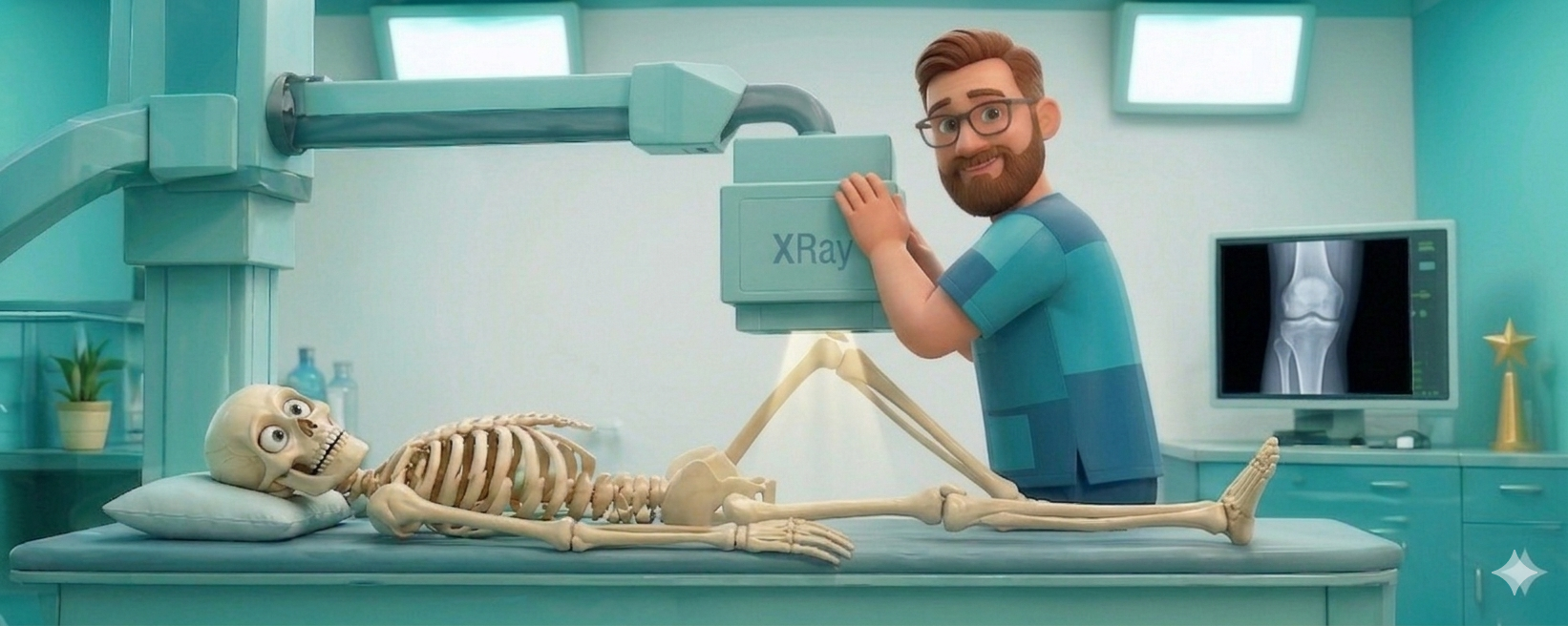
The Knee
The Knee is one of the most frequently imaged joints in radiography, serving as the complex hinge that bears the weight of the entire upper body. Because it relies on a delicate balance of ligaments, cartilage, and bone, even a few degrees of rotation can hide a tibial plateau fracture or obscure a joint space narrowing. In the “Richie Standard,” a diagnostic knee isn’t just about seeing the bone—it’s about demonstrating the joint space with absolute clarity to assist in orthopedic diagnosis.
The Goal
To demonstrate the distal femur, proximal tibia and fibula, and the patella with maximum detail, ensuring the femorotibial joint space is open and the soft tissue structures are visible for evaluating joint effusions.
Patient Positioning: Knee
- AP Knee: Place the patient supine with the leg extended. To ensure a true AP, internally rotate the leg approximately 3–5° (or until the epicondyles are parallel to the IR).
- Lateral Knee: Have the patient roll onto the affected side and flex the knee 20–30°. This degree of flexion is critical—too much flexion will tighten the musculature and obscure the joint space, while too little won’t show the patellofemoral space properly.
- The Richie Angle Rule: For the AP view, the Central Ray (CR) angle depends on the patient’s habitus (measured from ASIS to tabletop).
- 19–24 cm: 0° (average)
- >24 cm: 5° Cephalad (large)
- Pro-Tip: If you see the head of the fibula completely superimposed by the tibia on an AP view, the leg is rotated too far externally.
Specialty Views
- PA Axial (Tunnel View): Essential for visualizing the intercondylar fossa. This view is the gold standard for finding “joint mice” (loose bodies) or evaluating ACL attachment sites.
- Sunrise/Settegast (Patella): Specifically designed to view the patellofemoral joint space. This requires the patient to flex the knee significantly while the beam is angled tangential to the patella.
- Pro-Tip: Never attempt a Sunrise view or heavy flexion if a patellar fracture is suspected. Stick to the lateral and a non-flexed AP to avoid displacing the fracture.
Technical Factors
- Central Ray (CR): For the AP, direct the beam 1/2 inch distal to the apex of the patella. For the Lateral, angle 5–7° Cephalad to push the medial condyle up and superimpose the condyles perfectly.
- SID: 40″ standard.
- Collimation: Include the distal third of the femur and the proximal third of the tibia/fibula.
Image Evaluation Criteria (The “Richie” Checklist)
- Joint Space Clarity: The femorotibial joint space must be open. If it’s closed, check your CR angle or patient rotation.
- Superimposition (Lateral): On a perfect lateral, the posterior borders of the femoral condyles should be superimposed.
- Soft Tissue: The “fat pads” around the knee should be visible. Displacement of these pads (the “fat pad sign”) is a key indicator of internal joint trauma or effusion.
- Marker Accuracy: Your physical R/L marker must be clear and placed in the lateral light field.
Why These Views Matter
We use the AP and Lateral Knee to identify everything from degenerative joint disease (arthritis) to complex Tibial Plateau fractures. The Tunnel View is often the only way to see a femoral notch lesion, and the Sunrise view is the definitive way to diagnose patellar tracking issues or vertical patellar fractures.
Richie’s Pro-Tips for Knee Imaging
Stabilization: Use sponges under the ankle for the lateral view to keep the tibia horizontal. A steady patient is the key to preventing the “blur” that ruins a diagnostic image.
Weight-Bearing is Best: If the patient is being evaluated for arthritis, always perform the AP view standing (weight-bearing) if they are able. A supine knee can hide the true extent of cartilage loss that only appears under the pressure of body weight.
The 5-Degree Cephalad Lateral: Always use a slight cephalad angle on your lateral knee. This compensates for the fact that the medial femoral condyle sits slightly lower than the lateral condyle.
Physical Markers are Mandatory: Never rely on digital markers for joint imaging. Always place your lead marker on the IR to maintain legal and professional standards.
Knee
AP Knee
- CR: 1/2″ distal to apex of patella; angle 0°, or 5° cephalad based on habitus.
- SID: 40 inches.
- Position: Supine; leg extended; internally rotate leg 3–5° for true AP.
- Collimation: Include distal femur and proximal tibia/fibula.
- Richie’s Tip: If the patient is able, perform weight-bearing (standing) views to better evaluate for arthritis or joint space narrowing.
Oblique Knee (Internal/External)
- CR: 1/2″ distal to apex of patella.
- SID: 40 inches.
- Position: Rotate the entire leg 45° (medially for internal, laterally for external).
- Collimation: Ensure both femoral condyles and the proximal tib-fib joint are included.
- Richie’s Tip: The internal oblique is the best view for visualizing the proximal tibiofibular joint without superimposition.
Lateral Knee
- CR: 1″ distal to medial epicondyle; angle 5–7° cephalad.
- SID: 40 inches.
- Position: Affected side down; flex knee 20–30°.
- Collimation: Include the patellofemoral joint space and posterior condyles.
- Richie’s Tip: Use that 5-7° cephalad angle to push the medial condyle up and superimpose it perfectly with the lateral condyle.
Sunrise (Settegast)
- CR: Tangential to the patellofemoral joint space.
- SID: 40 inches.
- Position: Patient supine or prone; knee flexed at least 90° if possible.
- Collimation: Tight collimation to the patella and femoral sulcus.
- Richie’s Tip: NEVER attempt this view if a patellar fracture is suspected; stick to the non-flexed views to avoid displacing bone shards.