
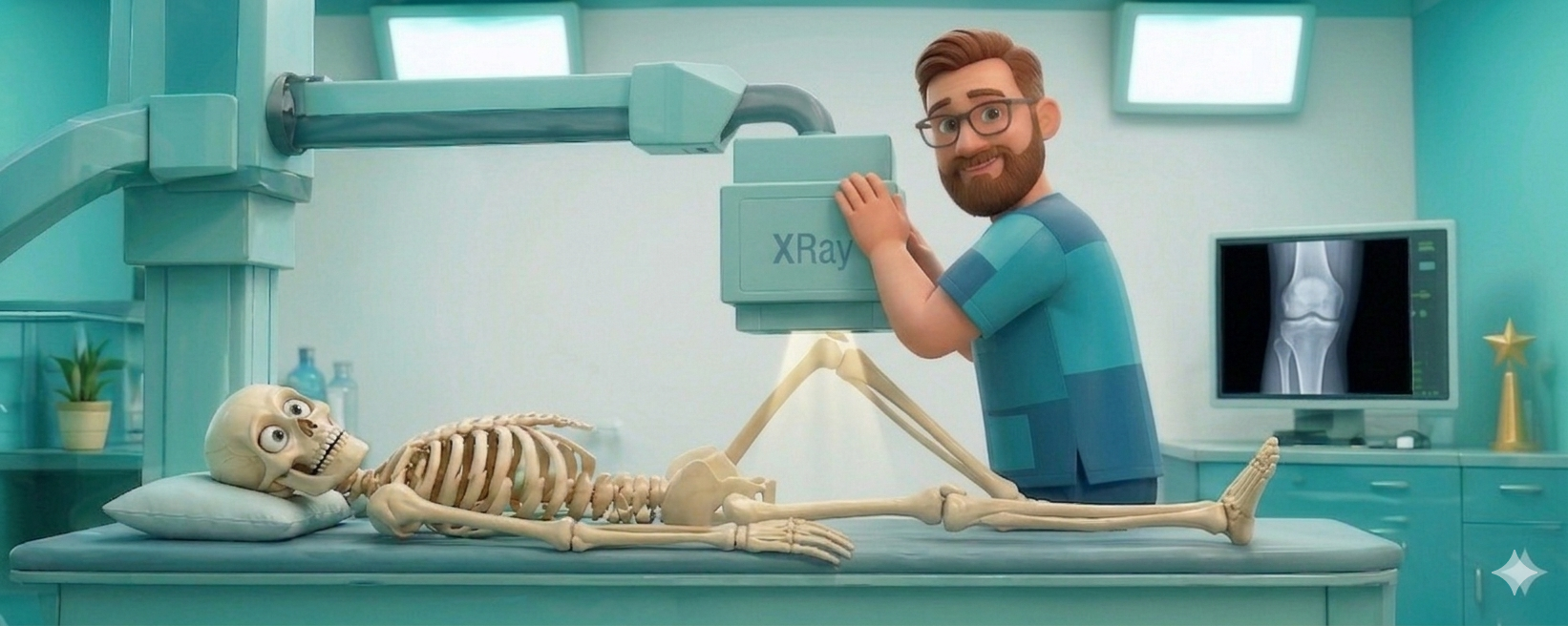
Oblique Knee
The Oblique Knee is the essential diagnostic bridge between the AP and Lateral views. While the standard projections are great for general alignment, the internal and external obliques are designed to “unroll” specific anatomical structures that are normally superimposed. For the orthopedic team, these views are the gold standard for visualizing the proximal tibiofibular joint and the individual femoral condyles without obstruction.
The Goal
To demonstrate the knee joint in a 45-degree rotation, specifically clearing the superimposition of the proximal fibula (Internal Oblique) or providing an unobstructed profile of the medial femoral condyle (External Oblique).
Patient Positioning: The 45° Rule
- Medial (Internal) Oblique: From the AP position, rotate the entire leg medially (inward) 45 degrees. This is the most critical oblique view because it clears the head of the fibula from the tibia.
- Lateral (External) Oblique: From the AP position, rotate the entire leg laterally (outward) 45 degrees. This view is used to profile the medial condyles and the posterior aspect of the tibia.
- Alignment: The knee should be centered to the midline of the IR, and the patient’s pelvis should remain flat to prevent compensatory rotation.
- Richie’s Stability Trick: Use a 45-degree foam wedge under the hip and calf to help the patient maintain the exact rotation. If they “drift” back toward the AP position during the exposure, the tibiofibular joint will remain closed.
Technical Factors
- Central Ray (CR): Perpendicular to the IR, directed 1/2 inch distal to the apex of the patella.
- SID: 40″.
- Collimation: Include the distal third of the femur and the proximal third of the tibia/fibula, with clear soft tissue margins.
Image Evaluation Criteria (The “Richie” Checklist)
- Internal Oblique Success: The proximal tibiofibular joint should be completely open. The lateral condyles of the femur and tibia should be in profile.
- External Oblique Success: The medial condyles of the femur and tibia should be in profile. The fibula should be superimposed by the lateral half of the tibia.
- Patellar Position: The patella should appear shifted toward the side of the rotation (medially for internal, laterally for external).
- No Motion: Cortical margins of the joint surface must be sharp to detect subtle “plateau” fractures.
- Physical Marker: Your physical R/L marker must be clear and placed in the lateral light field.
Why the Oblique View Matters
The internal oblique is often the only view that clearly shows a fracture of the fibular head or a lateral tibial plateau fracture. Because the fibula is usually tucked behind the tibia in a standard AP, the internal oblique “pulls” it out into the open for inspection.
Richie’s Pro-Tips for Oblique Knee Imaging
Professional Presence: Patients with knee injuries often have muscle guarding. Explain that the 45-degree turn is the best way to see “around the corner” of the bone to find the source of their pain.
Rotate from the Hip: Don’t just turn the foot; the entire limb from the hip down must be rotated 45 degrees to ensure the knee joint follows.
Physical Markers are Mandatory: Digital markers are a liability in orthopedic imaging. Always place your lead marker on the IR to maintain professional and legal standards.
The “Incomplete” Standard: Submitting an oblique where the fibula is still superimposed by the tibia on an internal view is technically non-diagnostic. Re-adjust and repeat if necessary.