
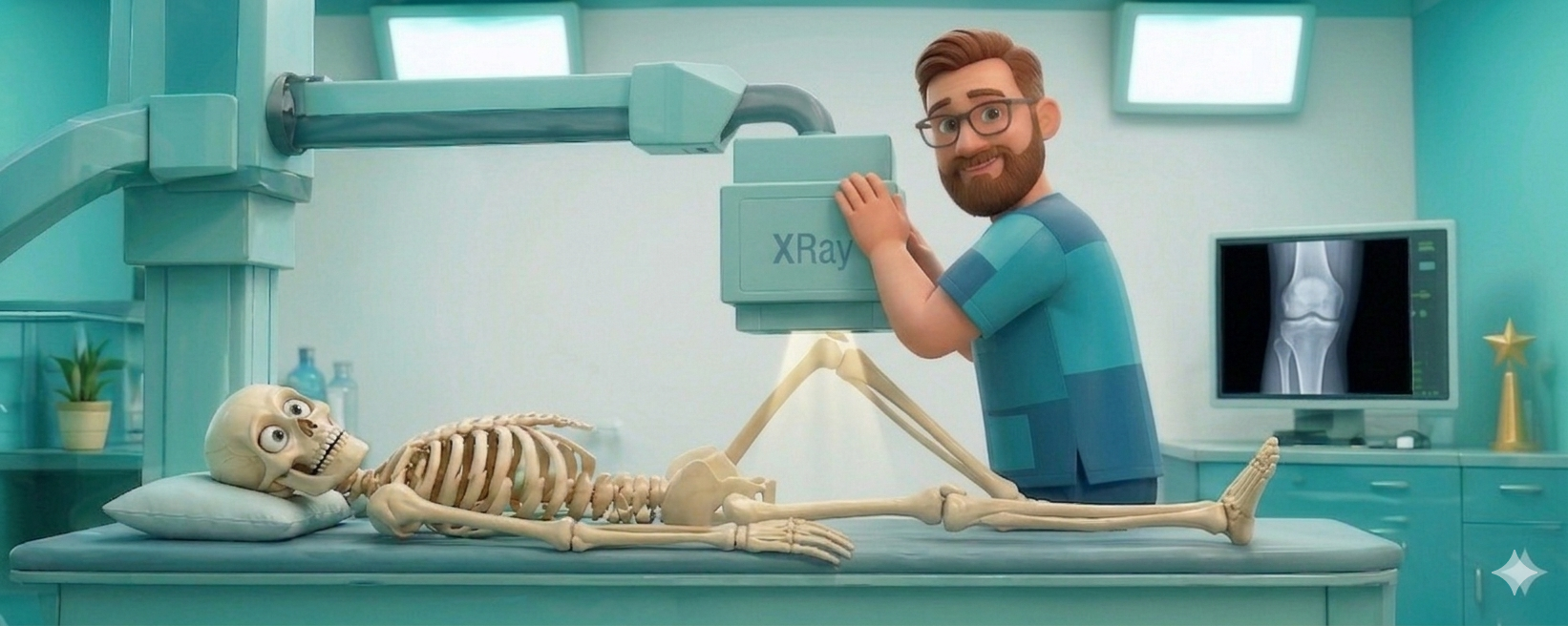
AP Knee
The AP Knee is the baseline projection for evaluating the most complex weight-bearing joint in the human body. Because the knee relies on precise alignment of the femur, tibia, and patella, achieving a true AP view is critical for diagnosing everything from acute tibial plateau fractures to the subtle joint space narrowing associated with osteoarthritis. A “Richie-approved” AP knee doesn’t just show the bones; it opens the joint space to tell the full story of the patient’s mobility.
The Goal
To demonstrate the distal femur and proximal tibia/fibula in a true anatomical position, ensuring the femorotibial joint space is fully open and the patella is centered between the femoral condyles.
Patient Positioning
- The Setup: Place the patient supine on the table with the leg fully extended.
- The Rotation: Internally rotate the entire leg approximately 3–5°. This movement is necessary to place the femoral epicondyles parallel to the image receptor.
- The Richie Habitus Rule: Your Central Ray (CR) angle is determined by the distance between the patient’s ASIS and the tabletop:
- Thin (<19 cm): Angle 5° Caudad (toward the feet) to follow the natural slope of the tibial plateau.
- Average (19–24 cm): 0° (perpendicular).
- Large (>24 cm): Angle 5° Cephalad (toward the head) to compensate for the way the femur angles in patients with wider hips.
- Pro-Tip: For patients with severe arthritis, the “Richie Standard” is to perform this view weight-bearing (standing) whenever possible to accurately assess joint space under physiological stress.
Technical Factors
- Central Ray (CR): Directed 1/2 inch distal to the apex of the patella.
- SID: 40″.
- Collimation: Include the distal third of the femur and the proximal third of the tibia/fibula, ensuring soft tissue margins are visible.
Image Evaluation Criteria (The “Richie” Checklist)
- Joint Space Clarity: The femorotibial joint space should be open and unobstructed.
- Symmetry: The femoral and tibial condyles should appear symmetrical, and the intercondylar eminence should be centered.
- Patellar Alignment: The patella should be centered over the distal femur, not pulled to one side.
- Fibular Head: There should be slight superimposition of the fibular head by the lateral tibial condyle. If the fibular head is completely “free,” the leg is rotated too far internally.
- Physical Marker: Your physical R/L marker must be clearly visible in the lateral light field.
Why the AP Knee Matters
This view is the first line of defense for identifying Tibial Plateau fractures, which can be easily missed if the joint space isn’t perfectly open. It is also essential for preoperative planning in total knee arthroplasty (TKA) and for monitoring the long-term stability of orthopedic implants.
Richie’s Pro-Tips for the AP Knee
Professional Presence: Many patients requiring knee X-rays are in pain or have limited range of motion. Use sponges to support the leg if they cannot fully extend, and always explain why that slight internal rotation is necessary for a diagnostic image.tandards.
Trust the Measurement: Don’t guess the CR angle based on visual appearance; use a caliper to measure the ASIS-to-tabletop distance. A 5-degree difference can be the factor that opens a closed joint space.
Physical Markers are Mandatory: Digital markers are a liability in orthopedic imaging. Always place your lead marker on the IR to confirm the correct side for the surgeon.
The “Incomplete” Standard: Submitting a knee image that clips the proximal fibula or distal femur is technically insufficient. Ensure your collimation allows for a full anatomical survey.