
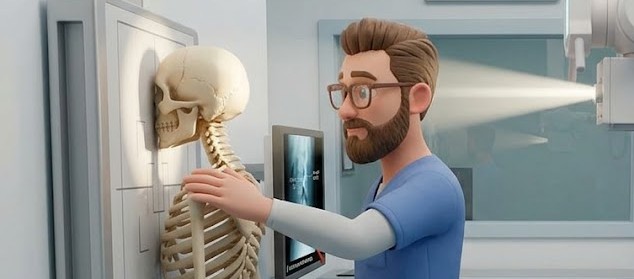
PA Skull / Facial Bones
Positioning for a PA Skull can be challenging, but it’s the standard for evaluating head symmetry and facial structures. Precision is everything here. By calming the patient and perfecting your alignment, you’ll be able to capture a diagnostic image every time. You’re the eyes of the doctor for this crucial exam, and you’ve got this!
Purpose
The primary goal of the PA Skull projection is to visualize the frontal bone, the facial bones, and the overall symmetry of the cranium. This “front-to-back” view is essential for visualizing trauma, demonstrating asymmetry, or shoiwing underlying disease. Clear images reduce repeat exposures and help clinicians make fast, confident decisions, especially when looking at the orbits and sinuses.
Patient Positioning
- Orientation: The patient can be positioned upright (standing or sitting) or prone, with their face placed against the image receptor (IR).
- Body Alignment: Even slight rotation or tilt will distort the anatomy. Ensure the midsagittal plane (MSP) is centered and perpendicular to the IR.
- Baselines: Bring the patient’s forehead and nose in contact with the table or wall Bucky. This naturally helps align the Orbitomeatal Line (OML) perpendicular to the IR. Watch the ears and orbits from behind to confirm the head is not tilted.
- Arms: Arms should be relaxed at the patient’s sides and out of the primary beam path.
Richie’s Tip: This projection requires a specific facial baseline. For a textbook image, check your lines from two directions. First, make sure the MSP is straight from the front. Then, from the side, bring the patient’s chin down to make the Orbitomeatal Line (OML) perpendicular to the IR. Slow down and recheck just before exposure.
Central Ray (CR)
- Centered to exit at the Nasion: Align the vertical CR line with the midsagittal plane (MSP).
- Horizontal Centering: Center the horizontal CR line to exit at the nasion (the bridge of the nose).
- Landmark: Recheck your nasion landmark just before exposure to ensure the head hasn’t drifted.
SID & Breathing
- SID: 40 inches.
- Breathing: Suspended. “Take a breath in, blow it all out, and hold it.” This prevents any involuntary motion during the exposure.
Common Errors
- Rotation: A slight turn of the head will misalign the entire projection. Your best check is to compare the distance from the lateral orbital border to the lateral margin of the skull on each side—they must be equal.
- Tilt: If the head is tilted to one side, the anatomy won’t line up correctly. Check the symmetry of the petrous ridges within the orbits. If one is higher than the other, the head is tilted.
- Landmark Miss: It’s easy to center too high or too low, especially on larger patients. Trust your nasion landmark and confirm the OML line remains perpendicular to the IR.
What Image Should Demonstrate
The final image should demonstrate a symmetrical view of the entire cranium. In a 0-degree PA projection, the petrous pyramids should fill the orbits. The ethmoid and frontal sinus cells should be clear, and the crista galli should be centered within the midsagittal plane.
Richie’s “Why It Matters” Note
Richie’s Tip: You might hear technologists debate PA vs. AP for skull imaging. All that means for you is: if your protocol allows a PA, use it! Bringing the facial bones closer to the IR significantly reduces magnification, providing sharper detail for the facial bones. Even better, it dramatically reduces the radiation dose to the patient’s eyes! That’s another great reason to master the PA technique! Keep protecting that patient!