
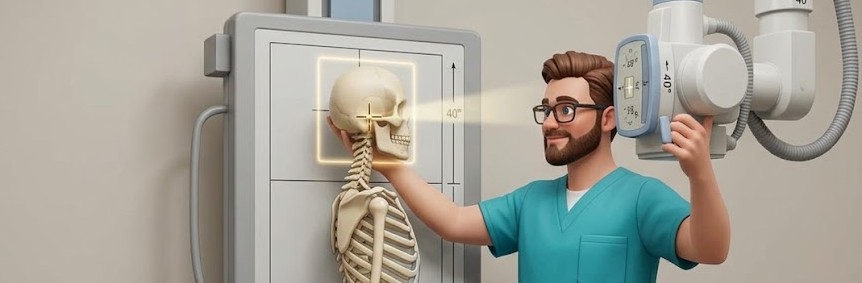
Head And Facial Bones
A clear, confidence‑building guide to skull and facial bone imaging for outpatient and urgent‑care environments.
Head and facial bone imaging requires precision, calm communication, and a strong understanding of anatomy. This section teaches caregivers how to position patients safely and consistently, even when pain, dizziness, or anxiety make the exam challenging. The goal is simple: clear images, safe technique, and repeat‑free workflows for very green learners.
All instructions emphasize:
- Patient safety
- Clear communication
- Correct positioning on the first attempt
- Reducing repeats and patient anxiety
What You’ll Learn in This Section
- How to position patients for skull and facial bone projections
- How to align the head, orbits, mandible, and sinuses correctly
- How to evaluate rotation, tilt, and anatomical symmetry
- How to support patients who have discomfort or limited head mobility
- How to avoid the most common repeat errors in head imaging
- How to communicate clearly during sensitive or uncomfortable exams
Why These Exams Matter
Head and facial bone radiographs help providers evaluate trauma, sinus disease, dental issues, orbital injury, and facial asymmetry. These exams often occur when patients are in pain or anxious. Clear, well‑positioned images reduce repeat exposures and help clinicians make fast, confident decisions.
Key Callouts for Beginners
1. Head Alignment Is Everything
Even slight rotation or tilt can distort anatomy. Use calm, simple cues to guide the patient into a neutral, stable position.
2. Support the Patient’s Comfort
Pain, dizziness, or anxiety can make positioning difficult. Use sponges, gentle hand placement, and slow movements to maintain stability.
3. Watch the Eyes and Chin
Small adjustments in chin elevation or eye line dramatically affect the projection. Move slowly and recheck before exposure.
4. Symmetry = Diagnostic Quality
For skull and facial bones, symmetry is the foundation of a readable image. Check ears, orbits, mandible angles, and midline structures.
5. Protect the Patient
Use shielding when appropriate and minimize repeats by verifying alignment before exposure.
Anatomy Highlights
Skull: frontal, parietal, temporal, occipital, sella turcica, sutures
Facial Bones: orbits, maxilla, mandible, nasal bones, zygomatic arches, sinuses
Repeat Avoidance
- Recheck rotation and tilt
- Confirm alignment
- Remove artifacts
- Use small, precise adjustments
- Stabilize before exposure
PA Skull / Facial Bones
- Place patient’s forehead and nose against the Bucky/IR.
- Align OML perpendicular to the IR.
- Ensure the MSP is perpendicular to the midline (no rotation/tilt).
- Center the CR to exit at the glabella.
- Suspend respiration during exposure.
Lateral Facial Bones
- Place the affected side against the IR in a true lateral.
- Align IPL perpendicular to the IR.
- Align IOML perpendicular to the front edge of the IR.
- Center CR to the zygoma (midway between outer canthus and EAM).
- Ensure no rotation or tilt of the head.
Waters View (Parietoacanthial)
- Extend neck, placing chin against the IR.
- Align MML perpendicular to the IR plane.
- OML should form a 37° angle with the IR.
- Center CR to exit at the acanthion.
- Watch for rotation; ensure MSP is perpendicular to IR.
Lateral Skull
- Place head in a true lateral position with the MSP parallel to IR.
- Align IPL perpendicular to the IR.
- Align IOML parallel to the long axis of the IR.
- Center CR 2 inches superior to the EAM.
- Collimate to include the entire cranium.