
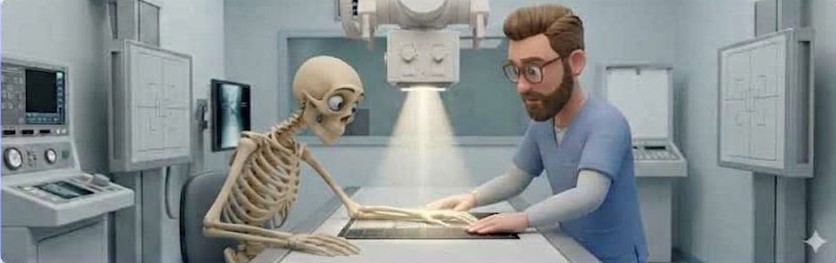
Lateral Elbow
The Lateral Elbow is the “money shot” for identifying joint effusion and subtle fractures. This 90-degree projection is the only way to visualize the anterior and posterior Fat Pads, which act as internal red flags for injury. A true lateral requires the humerus, elbow, and forearm to be on the exact same horizontal plane; if the shoulder is too high or the wrist is too low, the joint space will close and the anatomy will distort.
The Goal
To demonstrate the elbow joint in a true 90° lateral position, with the olecranon process in profile and the radial head partially superimposing the coronoid process.
Patient Positioning
- The Setup: Seat the patient at the end of the table with the arm flexed at a 90-degree angle.
- The Plane: Lower the patient’s chair or the table so that the shoulder, humerus, and elbow are all on the same level.
- The Rotation: Rotate the hand and wrist into a true lateral position with the thumb side up.
- The Epicondyles: The epicondyles of the distal humerus must be perpendicular to the image receptor.
- Pro-Tip: If the patient’s shoulder is “hiked up,” the distal humerus will be tilted, causing the epicondyles to be unstacked. Ensure the patient leans toward the affected side to drop the shoulder and flatten the humerus against the board.
Technical Factors
- Central Ray (CR): Perpendicular to the IR, directed to the mid-elbow joint.
- SID: 40″.
- Collimation: Include the distal 1/3 of the humerus and the proximal 1/3 of the radius and ulna.
Image Evaluation Criteria (The “Richie” Checklist)
A diagnostic Lateral Elbow must meet these professional standards:
- 90° Flexion: The elbow must be flexed at 90 degrees to properly displace the fat pads for evaluation.
- True Lateral: The olecranon process should be seen in profile, and the humerus epicondyles should be perfectly superimposed.
- Radial Head: The radial head should be seen partially superimposing the coronoid process.
- The “Fat Pad” Check: The anterior fat pad should look like a thin sliver, and the posterior fat pad should be invisible. If the posterior fat pad is visible, it indicates joint swelling.
- Physical Marker: Your physical R/L marker must be clear and placed in the light field anterior to the joint.
Why the Lateral View Matters
This view is legendary for the “Sail Sign”. When a patient has an occult (hidden) fracture, fluid builds up in the joint and pushes the fat pads away from the bone. Even if you don’t see a visible break in the radius or humerus, a displaced fat pad tells the radiologist that a fracture is almost certainly present. Without a perfect 90-degree lateral, these fat pads cannot be accurately assessed.
Richie’s Pro-Tips for the Lateral Elbow
Security and Privacy: Ensure the patient is properly shielded with lead and that the door is closed. A patient who feels secure is more likely to hold perfectly still for the exposure, preventing the motion blur that can hide subtle fat pad signs.mage with clipped anatomy—missing either the distal humerus or proximal forearm—is an ethical violation and an incomplete exam.
Watch the Wrist: Many patients let their wrist “roll” toward the table. If the wrist isn’t in a true lateral position, the proximal radius will rotate, potentially hiding a radial head fracture.
Physical Markers are Mandatory: Digital markers are not legally acceptable for orthopedic imaging. Always place your lead markers at the time of exposure to maintain medical-legal standards.
The “Incomplete” Standard: Submitting an image with clipped anatomy—missing the olecranon or the distal humerus—is an ethical violation and an incomplete exam.