
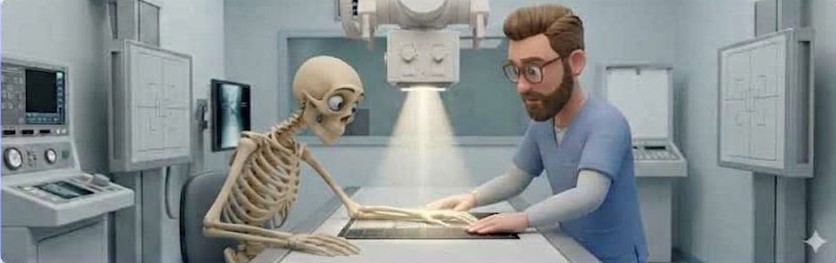
Elbow & Forearm
The Elbow and Forearm exams are foundational to orthopedic radiography. Because the forearm consists of two parallel bones—the radius and the ulna—that rotate around each other, your positioning must be exact to prevent one bone from hiding a fracture in the other. Whether you are looking for a “Fat Pad” sign in the elbow or a Galeazzi fracture in the forearm, the secret lies in keeping the anatomy perfectly parallel to the image receptor.
The Goal
To demonstrate the radius and ulna in their entirety, ensuring both the elbow and wrist joints are included and that the bones are shown with minimal distortion or superimposition.
Patient Positioning: Forearm
- AP Forearm: Seat the patient at the end of the table. Extend the arm and supinate the hand (palm up). This ensures the radius and ulna are parallel and not crossed.
- Lateral Forearm: Flex the elbow 90 degrees and rotate the hand into a true lateral position (thumb up). The humerus, elbow, and forearm should all be on the same horizontal plane.
- Pro-Tip: If the patient cannot supinate their hand for the AP view, do not settle for a “palm down” image. This causes the radius to cross over the ulna. Work with the patient to get the palm as flat as possible, or slightly elevate the shoulder to help the arm rotate.
Patient Positioning: Elbow
- AP Elbow: Extend the arm with the palm up. Ensure the epicondyles are parallel to the IR.
- Lateral Elbow: Flex the elbow 90 degrees. This is the “Gold Standard” for seeing the olecranon process in profile and checking for joint effusions (Fat Pads).
- Oblique Views: Use 45-degree internal and external rotations to “roll” the radial head and coronoid process out of superimposition.
- Pro-Tip: For the lateral elbow, make sure the patient’s shoulder is dropped low enough so the humerus is flat on the table. If the shoulder is hiked up, the elbow joint will appear “closed” on your image.
Technical Factors
- Central Ray (CR): Perpendicular to the mid-forearm for forearm views, or the elbow joint for elbow views.
- SID: 40″.
- Collimation: For the forearm, you must include both the wrist and elbow joints on one image. For the elbow, include the distal humerus and proximal forearm.
Image Evaluation Criteria (The “Richie” Checklist)
- Joint Inclusion: If you clip a joint on a forearm series, the exam is non-diagnostic and must be repeated.
- Proper Supination: On the AP forearm, the radius and ulna should not be crossed.
- True Lateral: On the lateral elbow, the radial head should partially superimpose the coronoid process, and the olecranon should be in profile.
- No Motion: Look for sharp cortical margins. If the “Fat Pads” are blurry, the image is not diagnostic for occult fractures.
- Physical Marker: Your R/L marker must be clear and placed in the lateral light field.
Why These Views Matter
In the elbow, we look for the “Fat Pad Sign.” A visible posterior fat pad or a displaced anterior fat pad (the “Sail Sign”) is a huge red flag for an intra-articular fracture, even if the bone looks normal at first glance. In the forearm, identifying the relationship between the radius and ulna is key to diagnosing dislocations that often accompany fractures, such as Monteggia or Galeazzi injuries.
Richie’s Pro-Tips for Elbow & Forearm Imaging
Privacy & Comfort: These views can be painful for trauma patients. Use sponges for support and ensure the room is private and the patient is shielded.
The “Long Bone” Rule: If the patient’s forearm is too long for the IR, take two images: one centered at the wrist and one at the elbow. Ensure there is plenty of overlap in the middle.
Physical Markers are Mandatory: Digital markers are not legally acceptable. Always place your physical lead marker in the light field at the time of exposure.
The “Incomplete” Standard: Submitting a forearm without both joints is an ethical violation. If a patient’s condition prevents a certain position, document it clearly for the radiologist.
Elbow
Forearm
AP Elbow
- CR: Perpendicular to the mid-elbow joint.
- SID: 40 inches.
- Position: Extend arm; hand supinated; epicondyles parallel to IR.
- Collimation: Distal humerus and proximal radius/ulna.
- Richie’s Tip: Ensure the elbow is fully extended to open the joint space and profile the epicondyles.
Internal Oblique
- CR: Perpendicular to the mid-elbow joint.
- SID: 40 inches.
- Position: Pronate hand; rotate entire arm 45° internally.
- Collimation: Distal humerus and proximal radius/ulna.
- Richie’s Tip: This is the best view to profile the coronoid process without superimposition.
Lateral Elbow
- CR: Perpendicular to the mid-elbow joint (lateral aspect).
- SID: 40 inches.
- Position: Flex elbow 90°; thumb up; humerus flat on the table.
- Collimation: Distal humerus and proximal radius/ulna.
- Richie’s Tip: Critical view for the “Fat Pad” sign; look for the olecranon process in profile.
AP Forearm
- CR: Perpendicular to the mid-forearm.
- SID: 40 inches.
- Position: Extend arm; hand supinated (palm up); epicondyles parallel to IR.
- Collimation: Must include both the elbow and wrist joints.
- Richie’s Tip: Hand supination is non-negotiable; if the hand is pronated, the radius crosses the ulna, obscuring potential fractures.
Lateral Forearm
- CR: Perpendicular to the mid-forearm.
- SID: 40 inches.
- Position: Flex elbow 90°; rotate hand to a true lateral (thumb up).
- Collimation: Must include both the elbow and wrist joints.
- Richie’s Tip: Ensure the humerus, elbow, and wrist are all on the same horizontal plane to prevent joint distortion.