
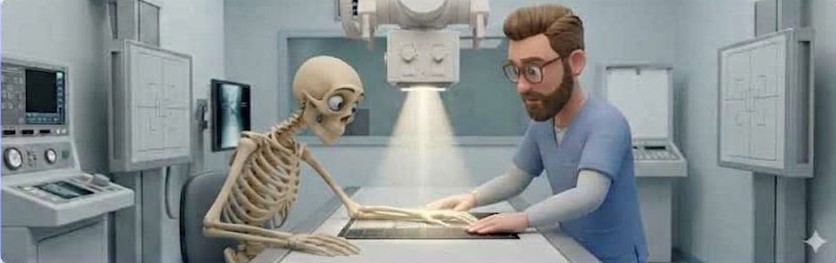
AP Forearm
The AP Forearm is the most critical projection for evaluating the relationship between the radius and the ulna. Because these two bones naturally cross over each other when the hand is prone, the AP view requires a full “palms up” position to unroll them. This allows for a clear assessment of the entire length of both bones and ensures that any fractures or dislocations at the proximal or distal joints are fully visualized.
The Goal
To demonstrate the radius and ulna in their entirety, ensuring they are seen in a true AP projection without superimposition, and including both the wrist and elbow joints.
Patient Positioning
- The Setup: Seat the patient at the end of the table with the arm fully extended on the IR.
- The Rotation (The “Palm Up” Rule): Instruct the patient to supinate the hand (palm facing the ceiling). This is the only way to ensure the radius and ulna are parallel.
- The Epicondyles: Ensure the humeral epicondyles are parallel to the IR to maintain a true AP orientation of the proximal forearm.
- The Richie “Flat Plane” Rule: The shoulder, elbow, and wrist must all be on the same horizontal plane. If the shoulder is too high, the joints will appear distorted.
- Pro-Tip: If the patient cannot fully supinate due to pain, have them lean their body toward the affected side. This can help rotate the forearm into a better AP position without forcing the wrist.
Technical Factors
- Central Ray (CR): Perpendicular to the IR, directed to the mid-forearm.
- SID: 40″.
- Collimation: You must include both the elbow and wrist joints, along with at least 1 inch of soft tissue on all sides.
Image Evaluation Criteria (The “Richie” Checklist)
Your AP Forearm is diagnostic only if it meets these standards:
- Joint Inclusion: Both the elbow and wrist joints must be completely visible. Clipping either joint makes the exam non-diagnostic.
- No Crossing: The radius and ulna should be parallel, with no crossing at the proximal or distal ends.
- Radial Head: The radial head, neck, and tuberosity should slightly superimpose the proximal ulna.
- Sharp Detail: Clear cortical margins and trabecular patterns must be visible throughout the shafts of both bones.
- Physical Marker: Your R/L marker must be clear and placed in the lateral light field.
Why the AP Forearm Matters
We use this view to look for displaced fractures and joint alignment issues like the Monteggia fracture (ulnar fracture with radial head dislocation) or Galeazzi fracture (radial fracture with distal radioulnar joint dislocation). Without including both joints in a true AP perspective, a dislocation at one end of the arm can be easily missed, even if the fracture in the middle is obvious.
Richie’s Pro-Tips for the AP View
Professional Presence: Patients in trauma are often guarded. Use a calm, steady presence to help them reach the supinated position, and use sponges for support to ensure they can hold still for the exposure.lipped anatomy—missing either the distal humerus or proximal forearm—is an ethical violation and an incomplete exam.
The “Long Bone” Challenge: If the forearm is longer than the 14×17 IR, you must take two separate exposures—one for the wrist and one for the elbow—with significant overlap in the middle.
Physical Markers are Mandatory: Always place your physical lead marker in the light field.