
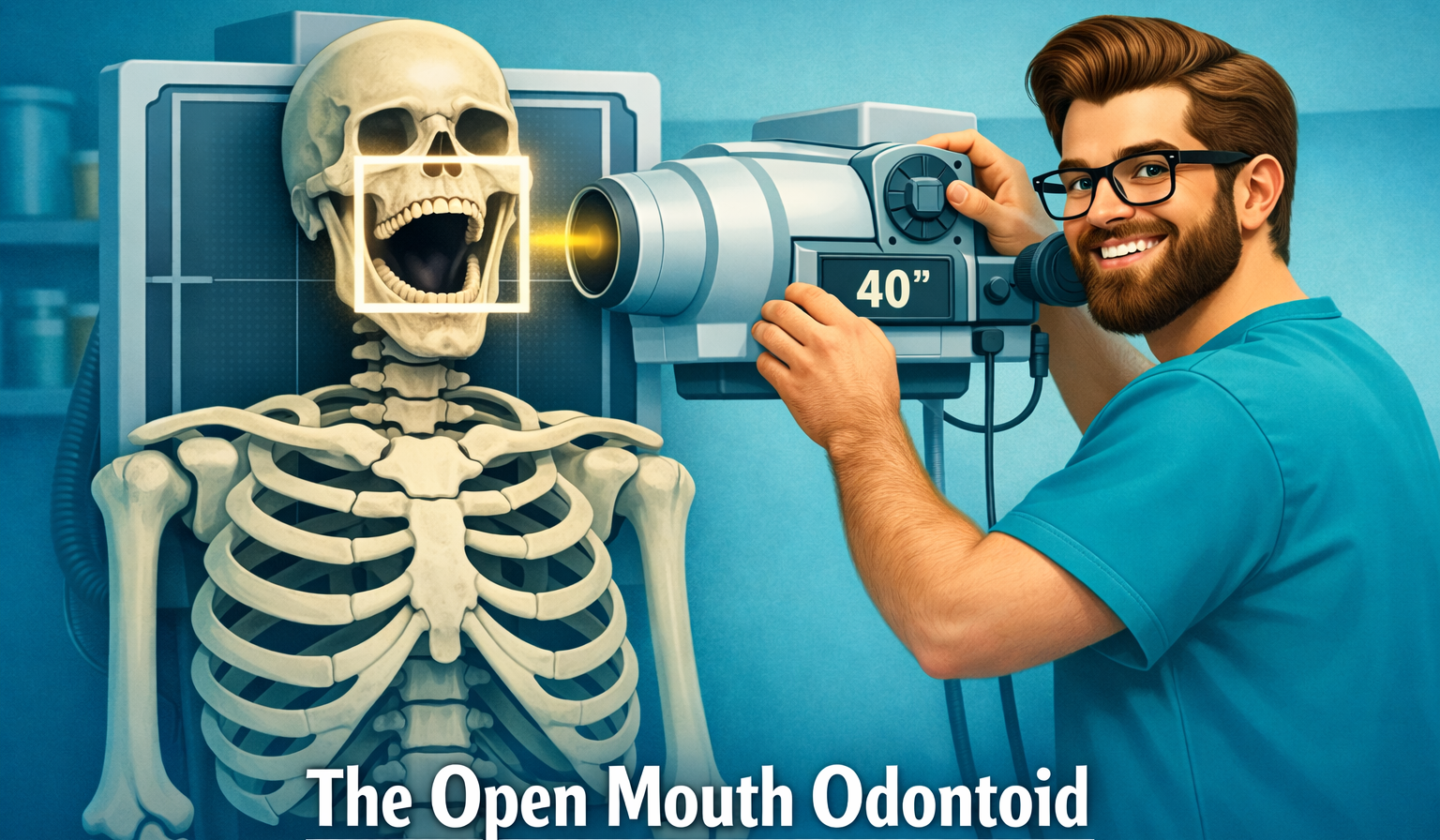
The Odontoid (Open Mouth) view is a specialized cervical spine projection used to visualize the dens (odontoid process) and the lateral masses of C1. This view helps visualize alignment, fractures, and stability at the C1–C2 articulation.
This projection requires precise positioning, patient cooperation, and careful alignment of the upper incisors and base of skull to avoid obscuring anatomy.
Purpose of the Exam
Demonstrates:
- Evaluate the odontoid process (dens)
- Assess C1–C2 alignment
- Demonstrate anatomy related to Jefferson fractures, odontoid fractures, or atlantoaxial instability
- Check for lateral mass displacement
- Rule out trauma‑related injury after cervical trauma
Patient Positioning
- Patient stands or sits upright facing away from the upright Bucky
- Back of the head gently against the IR
- Mouth opened wide on command
- Midsagittal plane perpendicular to the IR
- Shoulders relaxed and down
- Remove dentures, retainers, jewelry, or anything that may obscure anatomy
Part Positioning
- Align the upper incisors and base of the skull so they form a straight line
- This imaginary line should be perpendicular to the IR
- Instruct the patient to open their mouth as wide as possible
- Ensure the tongue is not elevated into the field (keep the tongue on the floor of the mouth)
- Keep the head straight — no rotation or tilt
Central Ray (CR)
- Perpendicular to the IR
- Directed through the open mouth
- Center at the midpoint of the open mouth
- SID: 40 inches
Collimation
- Collimate to the open mouth region
- Include:
- Odontoid process
- Lateral masses of C1
- Atlantoaxial joint spaces
- Upper portion of C2
Breathing
- Suspend respiration
Image Criteria
Must‑See Anatomy
- Odontoid process (dens)
- Lateral masses of C1
- Atlantoaxial joints
- Body of C2
Quality Checks
- Upper incisors and base of skull should be superimposed
- Dens should be centered and clearly visible
- No rotation (lateral masses symmetrical)
Common Positioning Errors
- Teeth obscuring the dens → Chin too low
- Base of skull obscuring the dens → Chin too high
- Rotation → Lateral masses not symmetrical
- Tongue shadow → Patient not instructed to keep tongue down
- Insufficient mouth opening → Anatomy blocked
Tips & Tricks
- Tell the patient: “Open your mouth like you’re saying ‘ahh’.”
- Watch the incisor–skull base line closely
- Reposition if the patient naturally tilts their head
- Use clear, calm instructions — this view requires cooperation
- If the patient cannot open their mouth (trauma), use the Fuchs or Judd method instead