
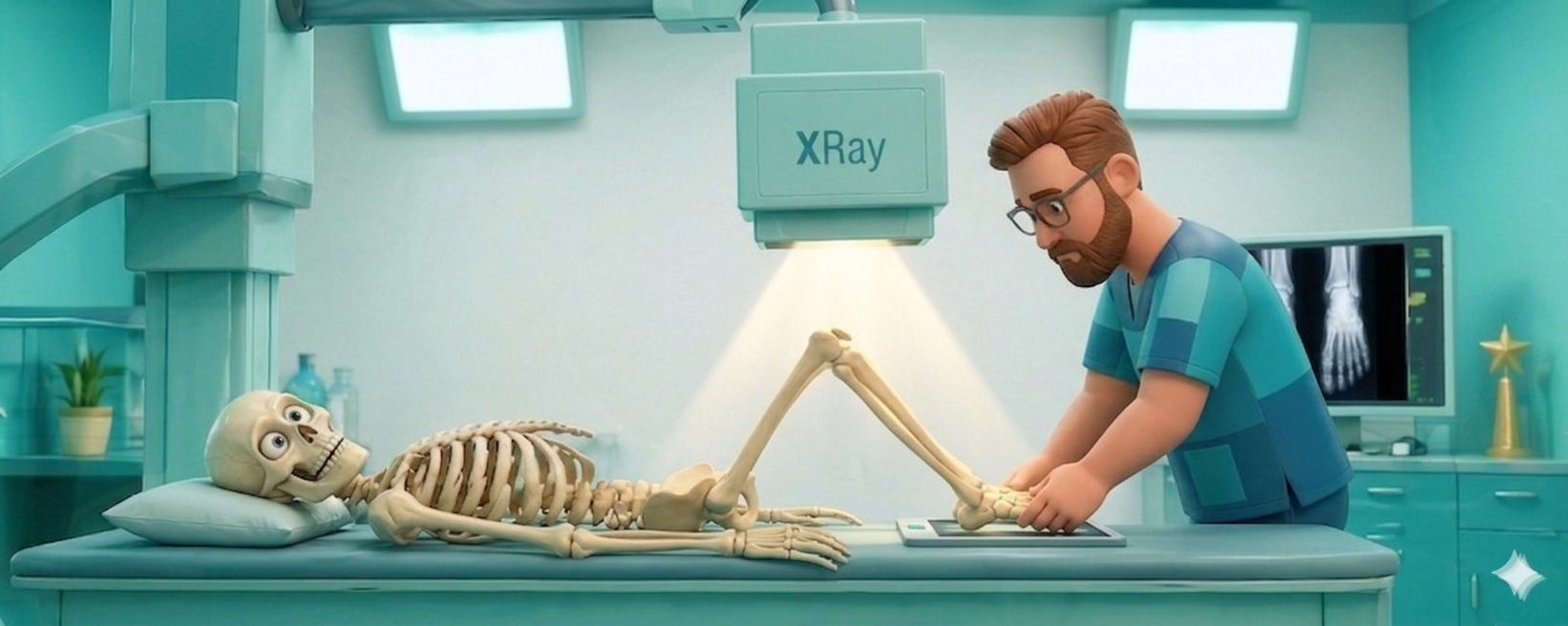
Medial Oblique Foot
The Medial Oblique Foot is arguably the most diagnostic projection in the foot series for visualizing the midfoot and lateral tarsals. While the AP view is excellent for the metatarsals, the oblique projection is specifically designed to “unroll” the foot, revealing the cuboid, the sinus tarsi, and the joints between the tarsal bones that are otherwise obscured by superimposition. In the “Richie Standard,” a perfect oblique must demonstrate the third through fifth metatarsals free of superimposition.
The Goal
To visualize the tarsal bones and the interspaces between the fifth metatarsal base and the cuboid, which are critical areas for identifying fractures and joint abnormalities.
Patient Positioning
- The Setup: Place the patient in a supine or seated position with the knee flexed.
- Rotation: Rotate the entire leg and foot medially 30° to 40°.
- Richie’s Reasoning: This specific degree of medial rotation is required to place the plantar surface of the foot at an angle where the cuboid is projected in profile and the sinus tarsi is opened.
- Centering: Center the foot to the IR, ensuring the base of the third metatarsal is the focal point.
- Pro-Tip: Use a 30° foam wedge sponge under the lateral side of the foot to help the patient maintain a steady, consistent angle throughout the exposure.
Technical Factors
- Central Ray (CR): Perpendicular to the IR.
- CR Entry Point: Directed to the base of the third metatarsal.
- SID: 40″ standard.
- Collimation: Ensure the field includes the distal phalanges through the calcaneus and the skin margins laterally.
Image Evaluation Criteria (The “Richie” Checklist)
- Cuboid in Profile: The cuboid should be demonstrated clearly without superimposition.
- Metatarsal Separation: The third through fifth metatarsals should be free of superimposition at their bases and shafts.
- Sinus Tarsi: The sinus tarsi should be visible and “open.”
- Tuberosity Visualization: The tuberosity at the base of the fifth metatarsal—a prime spot for fractures—must be clearly seen in profile.
- Physical Marker: A lead R/L marker must be visible in the light field.
Why the Medial Oblique Matters
This is the definitive view for identifying a Jones Fracture or an avulsion fracture of the fifth metatarsal base. Because the metatarsals are naturally staggered, the AP view often hides these lateral structures. By obliquing the foot medially, you “clear” the anatomy, providing the radiologist with an unobstructed look at the lateral column of the foot.
Richie’s Pro-Tips for the Medial Oblique Foot
Professional Presence: Patients with midfoot sprains often find the oblique rotation painful. Support the knee with a sponge and explain that the rotation is necessary to “un-stack” the bones for a better picture.
Don’t Under-Rotate: A common mistake is only rotating the foot 15–20°. If you don’t reach at least 30°, the metatarsals will remain superimposed, and the cuboid won’t be in profile.
Watch the Base of the 5th: I’ve seen many techs clip the base of the 5th metatarsal because they collimate too tight to the “toes.” Always remember that the foot ends at the heel—keep your light field wide enough to catch the entire lateral border.
Physical Markers are Mandatory: Digital markers don’t hold up in court or in a professional orthopedic clinic. Use your lead markers every single time.