
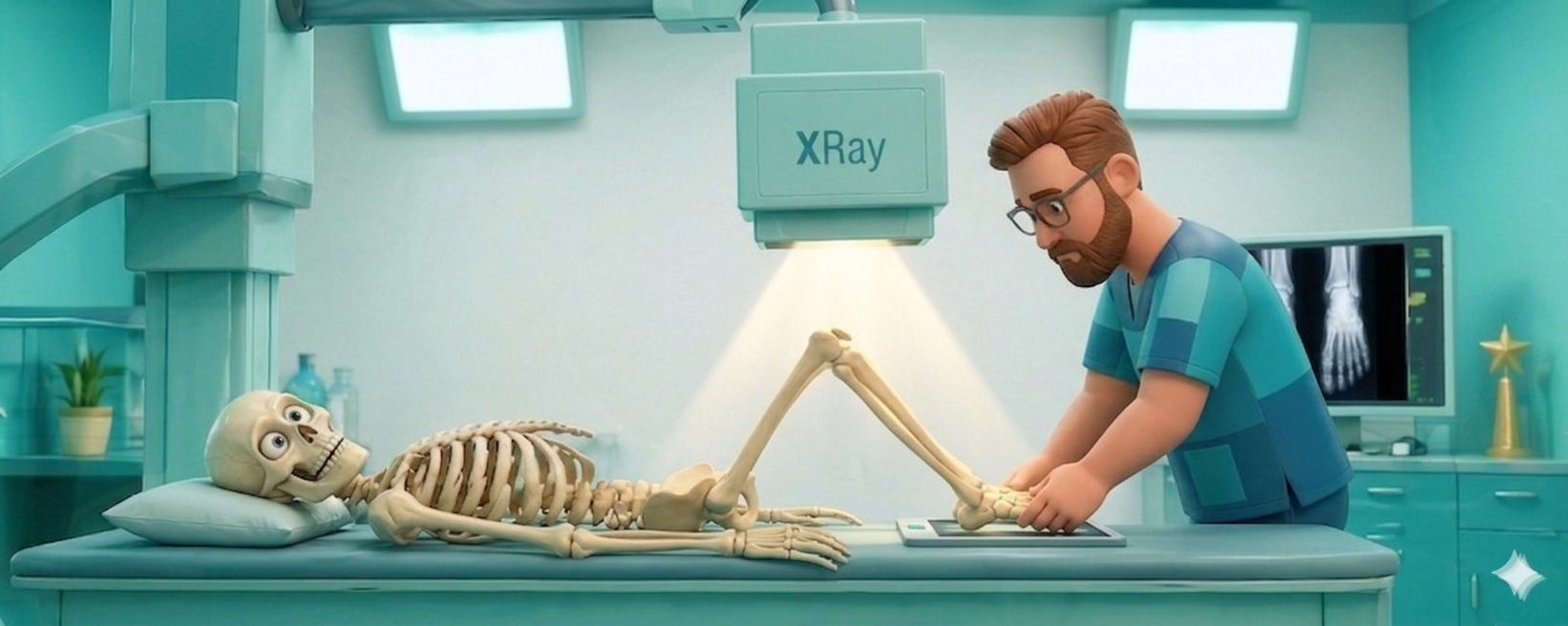
Ankle Mortise Oblique
The Ankle Mortise projection is arguably the most critical view in ankle radiography, specifically designed to visualize the entire joint space without the anatomical superimposition found in a standard AP view. In a true AP projection, the distal fibula overlaps the lateral portion of the talus; however, the Mortise view “un-stacks” these structures. In the “Richie Standard,” a successful Mortise view must demonstrate an open joint space across the medial, superior, and lateral aspects of the talus.
The Goal
To demonstrate the entire ankle mortise (the joint between the distal tibia, distal fibula, and the talus) in an unobstructed profile. This is the definitive view for assessing joint widening, which can indicate significant ligamentous injury or syndesmotic disruption.
Patient Positioning
- The Setup: Place the patient in a supine position with the leg fully extended.
- Internal Rotation: Rotate the entire leg and foot internally 15–20°.
- Richie’s Reasoning: The lateral malleolus sits more posteriorly than the medial malleolus. By rotating the leg inward 15–20°, you bring the intermalleolar line parallel to the image receptor (IR), opening the lateral joint space.
- Flexion: The foot should be dorsiflexed to 90° if the patient’s condition allows.
- Pro-Tip: Look at the malleoli; when the “bumps” on the sides of the ankle are at the same height from the table, you have likely achieved the correct 15–20° oblique.
Technical Factors
- Central Ray (CR): Perpendicular to the IR.
- CR Entry Point: Directed to a point midway between the malleoli.
- SID: 40″ standard.
- Collimation: Tight collimation to the ankle joint, including the distal tibia/fibula and the proximal talus.
Image Evaluation Criteria (The “Richie” Checklist)
- Open Joint Space: The medial, superior, and lateral joint spaces (the “mortise”) must be completely open.
- No Superimposition: The distal tibiofibular joint should be clear of superimposition.
- Malleoli Visualization: Both the medial and lateral malleoli should be seen in profile.
- Physical Marker: A lead R/L marker must be clear and positioned in the lateral light field.
Why the Mortise View Matters
In trauma cases, a “stable” looking AP ankle can hide a “widened” mortise. If the space between the talus and the fibula is greater than 3–4mm, it often suggests a tear of the tibiofibular syndesmosis (a “high ankle sprain”) or a fracture elsewhere in the leg, such as a Maisonneuve fracture. Without the proper 15–20° internal rotation, you simply cannot make this diagnosis.
Richie’s Pro-Tips for the Ankle Mortise
Professional Presence: Trauma patients are often in significant pain and may have a “splinted” leg. Work around the splint if possible, but prioritize the internal rotation of the anatomy over the orientation of the IR to ensure the joint is opened. to confirm the side of interest.
Rotate the Leg, Not Just the Foot: A common error is twisting the foot inward while the leg stays flat. This creates a “pseudo-oblique” that closes the joint. You must rotate the entire limb from the hip to get the tibia and fibula in the right plane.
The “15-Degree” Rule: If you rotate too much (like a 45° oblique), you will begin to superimpose the calcaneus over the ankle. Stay within that 15–20° sweet spot for a clean joint.
Physical Markers are Mandatory: Digital markers do not provide the legal or professional certainty required for orthopedic imaging. Always use lead.