
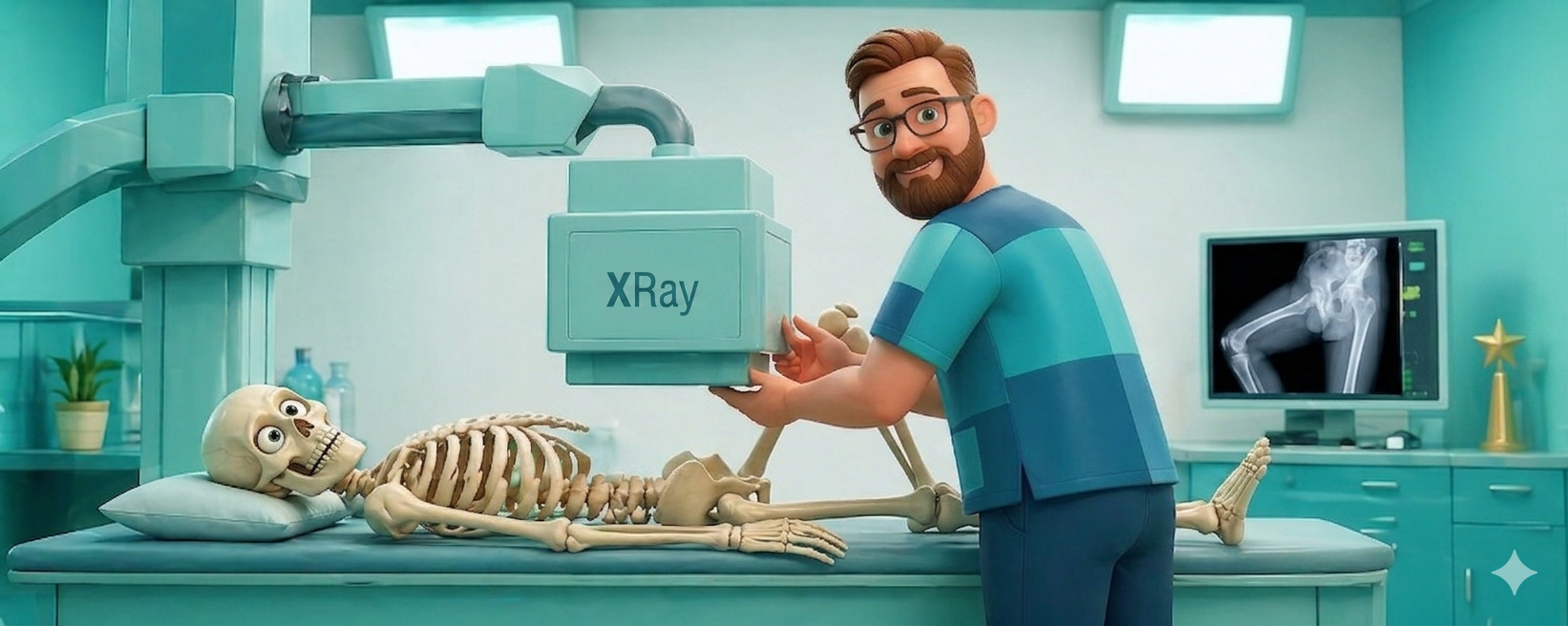
Frog-Leg Lateral Hip
The Frog-Leg Lateral (Modified Cleaves Method) is the essential companion to the AP Hip. While the AP view shows the “face” of the joint, the Frog-Leg perspective provides a specialized lateral profile of the femoral neck and head. This view is particularly valuable for identifying non-displaced fractures or assessing the alignment of orthopedic hardware after surgery. By abducting the leg, you move the greater trochanter out of the way, allowing for an unobstructed view of the femoral neck.
The Goal
To demonstrate a lateral projection of the femoral head, neck, and trochanteric area, with the femoral neck appearing in its true length without foreshortening.
Patient Positioning
- The Setup: Place the patient supine on the table.
- Flexion: Have the patient flex the knee and hip on the affected side, drawing the foot up toward the opposite knee.
- Abduction: Abduct the thigh approximately 45° from vertical. This “frog” position is what brings the femoral neck parallel to the image receptor.
- The Pelvis: Ensure the patient’s pelvis is not rotated; both ASIS should be equidistant from the tabletop to prevent distortion of the acetabulum.
- Richie’s Stability Trick: Use a large sandbag against the lateral aspect of the foot or knee to help the patient maintain the abduction. If they are in pain, they will naturally try to “close” the leg, which will ruin your lateral profile.
Technical Factors
- Central Ray (CR): Perpendicular to the IR, directed to the mid-femoral neck (approximately 3–4 inches distal to the ASIS).
- SID: 40″.
- Collimation: Include the acetabulum, the femoral head and neck, and the proximal third of the femoral shaft.
Image Evaluation Criteria (The “Richie” Checklist)
- Femoral Neck Profile: The femoral neck should be seen in its entirety, appearing end-on or slightly elongated depending on the degree of abduction.
- Trochanteric Relationship: The lesser trochanter should be prominent on the medial side of the femur, while the greater trochanter is mostly superimposed over the femoral neck.
- Acetabular Clarity: The relationship between the femoral head and the acetabulum must be clearly visible.
- No Motion: Cortical margins of the femoral head must be sharp to rule out subtle “subcapital” fractures.
- Physical Marker: Your physical R/L marker must be clear and placed in the lateral light field.
Why the Frog-Leg View Matters
This projection is the gold standard for non-trauma cases to check for Slipped Capital Femoral Epiphysis (SCFE) in younger patients or to evaluate the “fit” of a total hip replacement. However, NEVER attempt a Frog-Leg Lateral on a patient with a suspected acute fracture or dislocation. In those trauma cases, always stick to the Danelius-Miller (Cross-Table) method to avoid causing further neurovascular damage.
Richie’s Pro-Tips for the Frog Lateral
Professional Presence: This can be an uncomfortable and vulnerable position for patients. Maintain their dignity by using proper draping and explain exactly why the “frog” movement is necessary for a clear picture.
The 45-Degree Rule: If you abduct the leg too much (flat to the table), you actually start to foreshorten the neck again. Keep it at a steady 45-degree angle for the best diagnostic result.
Physical Markers are Mandatory: Always place your lead marker on the IR to confirm the correct side for the surgeon.
The “Incomplete” Standard: Clipping the acetabulum or the proximal femur makes this exam technically incomplete. Always feel for the ASIS to ensure your centering is high enough.