
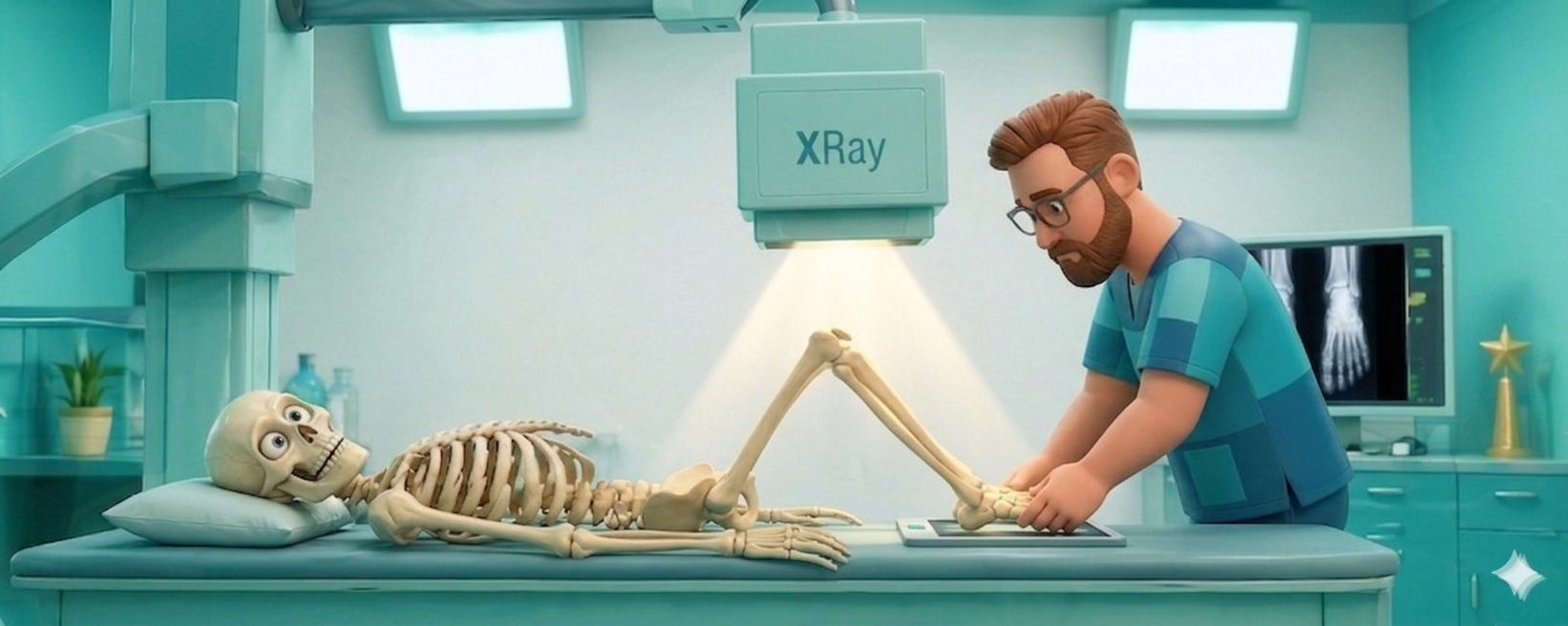
AP Foot
The AP Foot (also known as the dorsoplantar projection) is the primary view used to evaluate the structural integrity of the forefoot, midfoot, and the general alignment of the tarsals. Because the foot is wedge-shaped—thick at the heel and thin at the toes—this projection requires a specific tube angle to compensate for the anatomy. In the “Richie Standard,” a high-quality AP foot radiograph must clearly demonstrate the joint spaces between the tarsal bones and the metatarsals without significant foreshortening.
The Goal
To provide a clear, frontal demonstration of the phalanges, metatarsals, and tarsals (distal to the talus), allowing for the assessment of fractures, dislocations, or joint space narrowing.
Patient Positioning
- The Setup: Place the patient in a supine position or seated on the table with the knee flexed.
- Part Alignment: Ensure the plantar surface (sole) of the foot is flat against the image receptor (IR).
- Centering: Center the foot to the IR, ensuring the toes and calcaneus are included within the field of view.
- Pro-Tip: For trauma patients who cannot flex their knee, use a wedge sponge under the IR to create a similar relationship between the foot and the beam, or adjust your tube angle accordingly.
Technical Factors
- Central Ray (CR): Angle the CR 10° cephalad (toward the heel).
- Richie’s Reasoning: This 10-degree angle is crucial because it makes the beam perpendicular to the long axis of the metatarsals, opening the joint spaces and providing a more accurate representation of the tarsometatarsal joints.
- CR Entry Point: Direct the beam to the base of the third metatarsal.
- SID: 40″ standard.
- Collimation: Collimate to the skin margins on all sides, ensuring you include the distal phalanges through the talus.
Image Evaluation Criteria (The “Richie” Checklist)
- Joint Visualization: The joint spaces between the first and second cuneiforms should be open.
- No Rotation: The metatarsals should show nearly equal spacing, and the distal tibia/fibula should be superimposed by the talus.
- Penetration: Proper exposure should allow for visualization of both the delicate phalanges and the denser tarsal bones.
- Physical Marker: A lead R/L marker must be clearly visible and not superimposed over any anatomy.
Why the AP Foot Matters
This view is the first line of defense for identifying the “Jones Fracture”—a common break at the base of the 5th metatarsal. It is also essential for diagnosing Lisfranc injuries, where the metatarsals displace from the tarsal bones. Without that 10° cephalad angle, these joint spaces can appear closed, potentially hiding a significant ligamentous injury.
Richie’s Pro-Tips for the AP Foot
Professional Presence: Even a “simple” foot injury can be incredibly painful. Help the patient guide their foot onto the IR gently, and use sandbags or sponges to help them maintain the position if they are unsteady.
The “Jones” Checklist: Always double-check your lateral collimation to ensure the base of the 5th metatarsal isn’t clipped. It’s one of the most frequently fractured areas in the entire foot.
Angle for Anatomy: If the patient has a very high arch (pes cavus), you might need to increase your angle slightly (up to 15°) to open the joint spaces effectively.
Physical Markers are Mandatory: Digital markers have no place in a professional orthopedic study. Always use your lead markers to ensure the side is correctly identified for the radiologist.